Colònia Güell: Gaudí’s smartest half-day from Barcelona
In Santa Coloma de Cervelló, Colònia Güell pairs Gaudí’s extraordinary crypt with one of Catalonia’s most complete modernista factory settlements.
Why Colònia Güell stands out
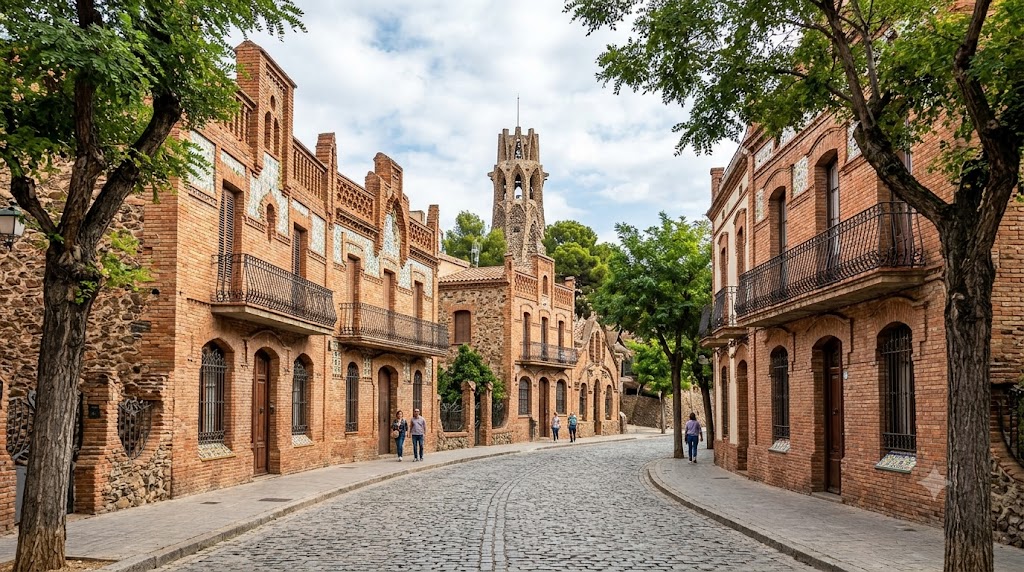
For travelers based in Barcelona, Colònia Güell is one of the rare half-day outings that feels both easy and genuinely substantial. In Santa Coloma de Cervelló, about 20 to 25 minutes away by FGC from Plaça Espanya, you are not visiting a single monument dropped into a tourist circuit. You are walking into a planned industrial colony that still reads as a place: streets, workers’ housing, civic buildings, the former cooperative, and the unfinished church where Antoni Gaudí tested ideas that would echo later in the Sagrada Família.
That combination is what makes the visit so smart. The museum angle here is unusually strong, even though much of the experience happens outdoors. The permanent exhibition and audiovisual at the visitor center give historical context, while the colony itself functions like an open-air modernista museum. Instead of isolating Gaudí from his setting, Santa Coloma de Cervelló lets you see how architecture, industry and daily life were meant to fit together.
Founded when the industrialist Eusebi Güell moved his textile factory from Sants to the Can Soler de la Torre estate in 1890, the settlement became one of the most distinctive worker colonies in Catalonia. Today, the historic complex remains the essential reason to come to Santa Coloma de Cervelló, and the atmosphere is very different from central Barcelona: quieter, more local, and far better for slow looking.
The crypt: Gaudí’s experimental masterpiece
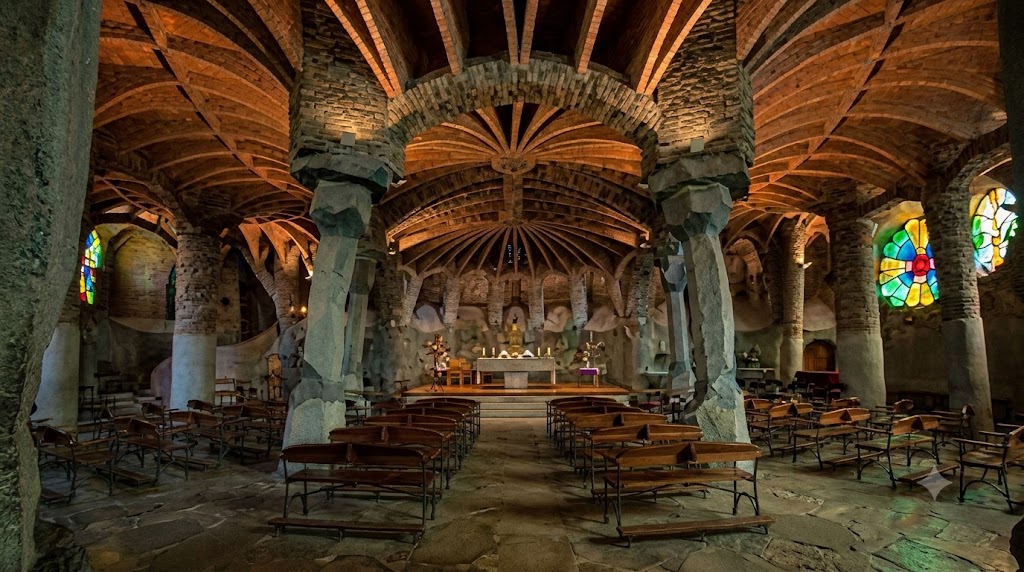
The undeniable centerpiece is the Church Crypt of Colònia Güell, often called simply the Gaudí Crypt. Although the larger church was never completed, the lower section is enough to justify the journey on its own. UNESCO included the crypt in the World Heritage listing of Gaudí works, and it is easy to understand why once you step inside.
This is where Gaudí pushed structure, geometry and symbolism in unusually concentrated form. Visitors notice the leaning basalt columns, the catenary logic, the organic handling of space and the stained glass that softens the interior rather than overwhelming it. The crypt feels less ceremonial than many famous churches and more like a working laboratory of ideas. That is part of its appeal: you can sense methods being tested, not just a finished signature style being displayed.
For museum-minded travelers, this matters. Colònia Güell is not merely “another Gaudí site.” It is one of the clearest places to understand process. In Santa Coloma de Cervelló, Gaudí’s architecture is inseparable from experimentation, and the unfinished state actually helps explain his thinking. If Park Güell and the Sagrada Família show public spectacle, the crypt shows design intelligence at close range.
What to look for inside
- The angled stone columns that seem to grow out of the ground rather than stand on it.
- The use of brick and rougher materials that give the space a tactile, workshop-like character.
- Stained glass and ironwork integrated into the architecture instead of treated as separate decoration.
- The relationship between the crypt and the wooded slope around it, which reinforces Gaudí’s interest in natural forms.
The open-air museum of the colony
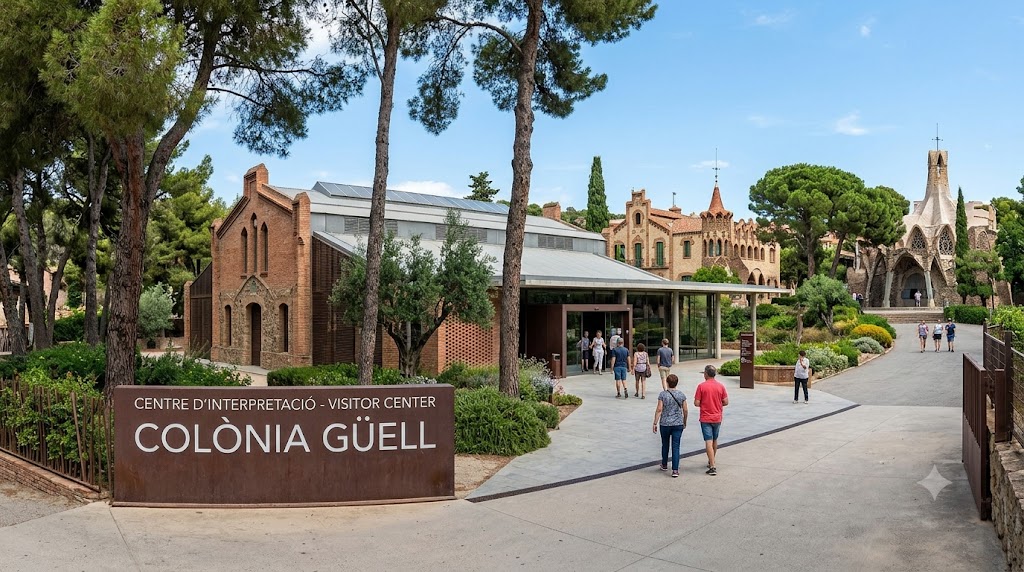
Do not make the mistake of treating the crypt as a quick stop before heading back to Barcelona. The real strength of Colònia Güell is the wider ensemble in Santa Coloma de Cervelló. The visitor center organizes access to the permanent exhibition, the audiovisual, the crypt and the route through the colony, and together these elements create a fuller museum experience than many single-building sites.
Walking the colony, you see how modernisme operated beyond elite mansions and urban showpieces. Here it shaped workers’ houses, public spaces and communal buildings. The former cooperative building, now the interpretation center, is central to that understanding. So are the streets and houses that preserve the settlement’s original logic. This is architecture as social planning, not just architecture as spectacle.
That distinction gives Santa Coloma de Cervelló a special place among day trips from Barcelona. Many visitors know Gaudí through famous landmarks, but Colònia Güell broadens the story. It also brings in lesser-known modernista architects associated with the colony, which means the walk is richer than a simple Gaudí checklist. The result is one of the most coherent heritage environments in the Baix Llobregat area.
How to pace your visit
The official visit duration for the full experience is around 1 hour 30 minutes to 2 hours, but many travelers will want longer if they enjoy architecture or photography. A good half-day in Santa Coloma de Cervelló usually means allowing time for the exhibition first, then the crypt, then an unhurried walk through the residential and civic parts of the colony. Because the site is compact and explored on foot, it rewards attention better than speed.
Why Santa Coloma de Cervelló matters, not just “near Barcelona”
It is tempting to describe Colònia Güell only as a Gaudí excursion from Barcelona, but that undersells Santa Coloma de Cervelló. The municipality is not just a transport node for a famous monument. It is the place that preserves the colony’s context: the relationship between the industrial settlement, the older town, and the broader Baix Llobregat landscape.
That local grounding changes the experience. In central Barcelona, Gaudí can feel monumental and crowded. In Santa Coloma de Cervelló, his work sits within a lived environment. Even the approach from Colònia Güell station helps; you arrive through an ordinary urban rhythm and then enter a heritage site that still functions as part of a town. For visitors interested in museums, urban history or industrial heritage, that continuity is one of the destination’s biggest strengths.
The municipality also frames the colony as part of a larger cultural heritage network that includes protected historic assets and rural traces that survive in the territory. But if you only have half a day, Colònia Güell remains the focus because it concentrates Santa Coloma de Cervelló’s most distinctive identity in one walkable area.
Practical tips for a smooth half-day
Getting here is simple. The official visitor information states that FGC lines S3, S4, S8 and S9 run from Plaça Espanya to Colònia Güell station in roughly 20 to 25 minutes, and from the station it is a short walk to the visitor center on Carrer Claudi Güell. Driving is also possible, and official information notes free parking for cars and coaches.
The standard ticket includes the Gaudí Crypt, audio guide and permanent exhibition, while guided tours are also available. The audio guide is offered in multiple languages, which helps first-time visitors understand the colony as more than a photogenic backdrop. Accessibility information is also useful: the visitor center, permanent exhibition, route through the colony and the interior of the crypt are accessible, though the choir and roof are not.
If you are deciding between a rushed look and a fuller visit, choose the fuller one. Colònia Güell is best when approached as a museum district in miniature rather than a single attraction. Arrive with enough time to read, listen and wander.
Useful planning notes
- Start at the visitor center rather than going straight to the crypt.
- Use the exhibition and audiovisual to make sense of what you will see outdoors.
- Wear comfortable shoes; the value of the visit is in walking the colony slowly.
- If you are traveling with children, the site offers a clue-based activity for ages 6 to 10.
- Keep expectations focused on quality, not scale: this is a compact site with remarkable depth.
The verdict
Colònia Güell is one of the most rewarding museum-oriented excursions in the Barcelona area because it offers several experiences at once: a UNESCO-listed Gaudí work, a strong interpretation center, and one of Catalonia’s most evocative modernista industrial settlements. In Santa Coloma de Cervelló, those parts remain legible together, which is increasingly rare.
If your idea of a good half-day involves understanding a place rather than merely ticking off a landmark, this is the right choice. The crypt supplies the genius, but the colony supplies the meaning. That is why Colònia Güell is not simply a convenient detour from Barcelona. It is Santa Coloma de Cervelló’s most convincing cultural experience, and one of Gaudí’s smartest visits anywhere.
Was this travel report helpful for your journey?
Let our editorial desk know how this coverage assisted your plans.